
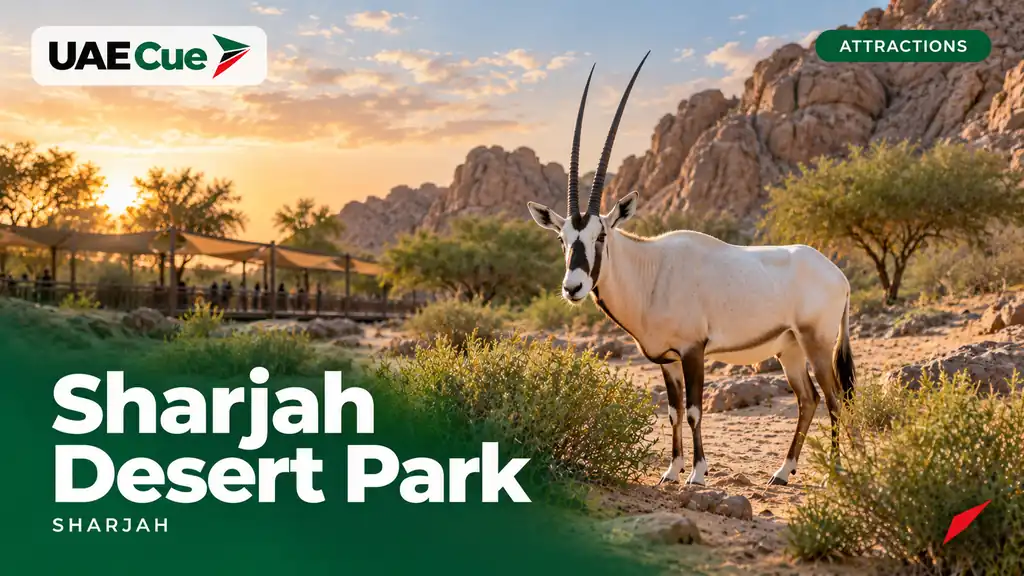
Sharjah Desert Park costs about AED 15 for adults, and children under 12 go free, with one ticket covering all four centres: Arabia’s Wildlife Centre, the Natural History Museum, the Botanical Museum with its Islamic Garden, and the Children’s Farm. It opens Sunday, Monday, Wednesday and Thursday from 9am to 5:30pm, Saturday from 11am and Friday from 2pm, and is closed on Tuesdays. Allow three to five hours. It is on Al Dhaid Road (E88) at Interchange 9, about 30 minutes from Sharjah city and 40 minutes from Dubai, and most of it is indoors and air-conditioned.
At a glance
- Adults
- About AED 15
- Children
- Under 12 free; teenagers about AED 5
- One ticket
- All four centres
- Hours
- Sun, Mon, Wed, Thu 9am to 5:30pm; Sat 11am to 5:30pm; Fri 2pm to 5:30pm
- Closed
- Tuesdays
- Allow
- 3 to 5 hours
- Where
- Al Dhaid Road (E88), Interchange 9, Sharjah
Last verified: 13 October 2026 against the park’s published visitor information and recent visitor reports. Some recent posts mention a higher adult price, so check at the counter.
On this page
Tickets and opening hours
| Ticket | Price |
|---|---|
| Adult | About AED 15 |
| Teenager, 12 to 16 | About AED 5 |
| Child under 12 | Free |
| All four centres | Included in one ticket |
| Day | Hours |
|---|---|
| Sunday, Monday, Wednesday, Thursday | 9am to 5:30pm |
| Saturday | 11am to 5:30pm |
| Friday | 2pm to 5:30pm |
| Tuesday | Closed |
Hours change during Ramadan and on some public holidays. Buy tickets at the main entrance; arrive by 2pm on a weekday to see all four centres without rushing.
Do not go on a Tuesday. The whole park is closed, and it is the most common reason families drive out for nothing.
What is inside each centre
| Centre | What you see | Time | Best for |
|---|---|---|---|
| Arabia’s Wildlife Centre | Native Arabian animals in large enclosures, viewed from indoor air-conditioned walkways, plus reptile, insect and nocturnal houses and an aviary | 1.5 to 2 hours | Everyone; the highlight |
| Sharjah Natural History Museum | Five halls on the region’s geology, fossils, meteorites, desert life and the sea | 45 to 60 minutes | Older children and adults |
| Botanical Museum and Islamic Garden | The plant life of the Arabian Peninsula, and a garden of the plants mentioned in the Quran and Sunnah | 30 to 45 minutes | A calm walk |
| Children’s Farm | Goats, sheep, camels, horses, cows and ducks to feed and pet | 30 to 45 minutes | Young children |
Arabia’s Wildlife Centre
Opened in 1999, Arabia’s Wildlife Centre (often written Arabian Wildlife Centre) was the UAE’s first centre devoted entirely to the wildlife of the Arabian Peninsula, and it is still the best place in the country to see it. You walk through indoor, air-conditioned galleries with large windows onto outdoor desert and mountain enclosures, so you can watch animals in natural settings even in summer.
- Big cats and predators: the critically endangered Arabian leopard, caracal, Arabian wolf, striped hyena and several species of fox.
- Hoofed animals: Arabian oryx, the UAE’s national animal, and gazelles.
- Primates: a troop of hamadryas baboons.
- Nocturnal house: desert animals that come out at night, kept in a darkened hall, including Egyptian fruit bats.
- Reptiles, fish and insects: snakes including the Arabian cobra, lizards, scorpions, and the Omani blind cave fish.
- Aviary: native birds in a walk-through area.
Behind the scenes, the park’s Breeding Centre for Endangered Arabian Wildlife, founded in 1998, runs breeding programmes for species such as the Arabian leopard and has expanded with a large new phase. It is not open to the public, but many of the animals you see are part of its work.
The museums and gardens
The Sharjah Natural History Museum tells the story of the land and sea around Sharjah, from rocks and fossils to meteorites, desert ecosystems and marine life, across five halls. The Botanical Museum, opened in 2008, uses interactive displays to explain the plants of the region, from algae and mushrooms to desert shrubs and trees. Outside, the Islamic Garden, opened in 2014, grows around 44 plant species mentioned in the Quran and the Prophet’s Sunnah, with signs explaining each.
The Children’s Farm
The farm is where younger children spend most of their time: they can feed and pet goats, sheep, camels, horses, cows and ducks, with staff on hand. Wash hands after feeding; there are basins near the farm. It is outdoors, so in the warmer months go in the morning or the last hour before closing.
Food, facilities and rules
- Food: two small cafés, kiosks and a restaurant with panoramic views over part of the wildlife centre. Outside food is allowed in the designated picnic areas.
- Access: most sections are wheelchair and stroller friendly.
- Photography: allowed in the wildlife centre without flash, but not in most museum halls.
- Animals: do not tap on the glass or feed the wild animals; feed only the farm animals with food from the farm.
- Parking: free, on site.
- Pets: not allowed, as the park is a wildlife centre.
About the park
Sharjah Desert Park was established in 1995 inside the Seih Al Masmout protected area as a conservation and education centre for the plants and animals of the Arabian Peninsula. It covers about one square kilometre and is run by Sharjah’s Environment and Protected Areas Authority, which also runs Sharjah Safari and the emirate’s other wildlife centres.
Best time to visit
- October to April for the outdoor farm and gardens.
- Summer works too, because the wildlife centre and museums are indoors and air-conditioned; do the farm first thing.
- Weekday mornings are quietest; Saturday afternoons are the busiest.
- Animals are most active in the morning and late afternoon.
Getting there and what is nearby
Take Al Dhaid Road (E88) east from Sharjah and leave at Interchange 9, about 28 to 30 km from the city centre. From Dubai, allow 35 to 45 minutes via the E311 or E611 and the E88. A taxi works from Sharjah, but there is little public transport out here, so driving is easiest.
- Sharjah Safari: the big African safari near Al Dhaid, about 30 minutes further east.
- Buhais Geology Park and Mleiha: fossils and archaeology in the Sharjah interior.
- Places to visit in Sharjah: museums, souks and waterfronts in the city.
- Small zoos and farms in the UAE: easy outings for young children.
- Dubai Safari Park: open again from 12 October.
- Umm Al Quwain Zoo: giraffe feeding and big cats.
- UAE theme parks and zoos: every big family attraction compared.
- Sharjah National Park: on the same road, nearer the city.
Sharjah Desert Park FAQs
How much is the Sharjah Desert Park ticket?
Adults pay about AED 15, teenagers about AED 5, and children under 12 enter free. One ticket covers all four centres.
What are Sharjah Desert Park timings?
It opens 9am to 5:30pm on Sunday, Monday, Wednesday and Thursday, 11am to 5:30pm on Saturday and 2pm to 5:30pm on Friday. It is closed on Tuesdays.
Is Sharjah Desert Park closed on Tuesday?
Yes. The whole park, including Arabia’s Wildlife Centre and the Children’s Farm, is closed every Tuesday.
What animals are at Arabia’s Wildlife Centre?
Native Arabian species including the Arabian leopard, Arabian wolf, caracal, striped hyena, Arabian oryx, gazelles, baboons, foxes, snakes, scorpions and fruit bats.
How long do you need at Sharjah Desert Park?
Three to five hours to see Arabia’s Wildlife Centre, the museums, the gardens and the Children’s Farm without rushing.
Is Sharjah Desert Park good in summer?
Yes. The wildlife centre and museums are indoors and air-conditioned. Visit the Children’s Farm early in the morning or late in the afternoon.