
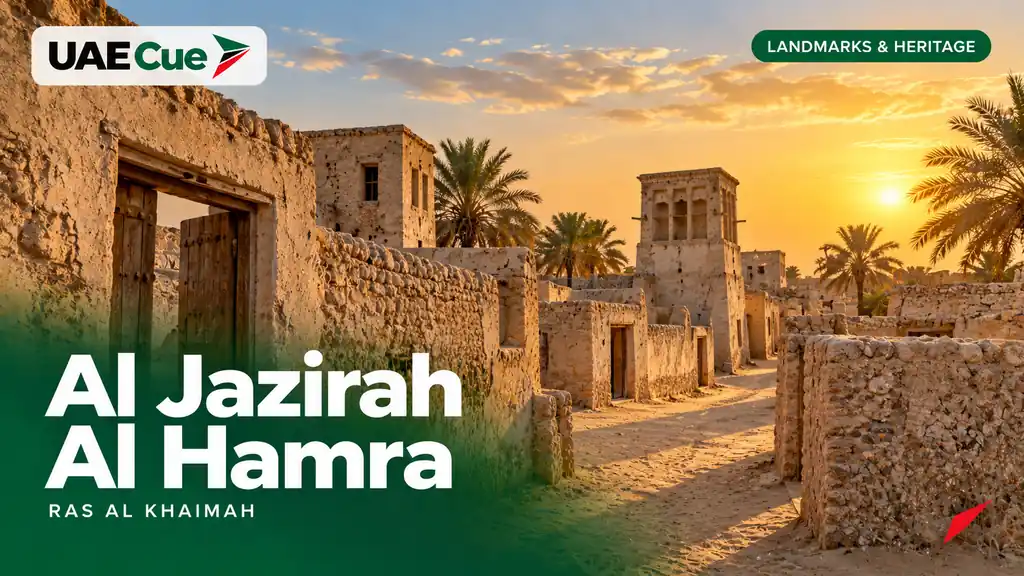
Al Jazirah Al Hamra (also spelled Jazeera Al Hamra, meaning “the red island”), the “ghost town” of Ras Al Khaimah, is a free-to-visit abandoned pearling village of coral-stone houses, wind towers, mosques, a souk and a fort, about 20 km south of RAK city and an hour from Dubai. It is open Tuesday to Sunday from about 10am to 6pm. Some buildings, including the fort and several courtyard houses, have been restored, while much of the village has been left in its original, crumbling state. Go in the late afternoon from October to April for the warmest light on the coral walls, wear closed shoes, and stay out of roofless or fenced-off buildings.
At a glance
- Entry
- Free
- Hours
- Usually Tuesday to Sunday, 10am to 6pm; closed Monday
- Where
- Al Jazirah Al Hamra, Ras Al Khaimah, off the E11, near Al Hamra Village and Al Marjan Island
- From Dubai
- About 1 hour to 1 hour 15 minutes
- Time needed
- 1 to 2 hours
- Best light
- Late afternoon, or the first hour after opening
- Abandoned
- 1968
Last checked: 14 October 2026. Ras Al Khaimah publishes no separate visitor page for the village; hours come from current listings and can change during events.
On this page
Why it is a ghost town
The Emirati village was founded in the late 16th century on a tidal island by the Za’ab (Al Zaabi) tribe, and grew rich on pearling: around 1900 it had about 500 houses and some 25 pearling boats. When the pearl trade collapsed in the late 1920s and oil changed the region’s economy, the town declined. In 1968, after a dispute with the Ruler of Ras Al Khaimah, most of the tribe accepted an offer from Sheikh Zayed to move to Abu Dhabi, and the village of about 2,500 people was left almost empty.
What remains is described as the last intact pre-oil pearling and seafaring town in the Gulf, and it is on UNESCO’s tentative list as the pearl trading town of Jazirat Al Hamra. Local folklore says jinn moved in when the people moved out, which is how it earned its “ghost town” name and its place on lists of the UAE’s most haunted places.
What is restored and what is ruined
| Part of the village | State today |
|---|---|
| The fort | Restored; used as an exhibition space during the art festival |
| Central mosque and smaller mosques | Restored or stabilised; one old mosque stands in the abandoned part |
| Merchant and courtyard houses, such as Bayt Abdulkareem | Several restored, some with photographs and artefacts inside |
| Wind-tower (barjeel) houses | Many intact or semi-ruined; a rare look at traditional cooling |
| Old souk street | Partly restored lanes |
| Outer houses and watchtowers | Left in original, crumbling condition |
Restored buildings may only be open during events, so expect to see most of the village from its lanes and courtyards.
A walking route
- Start at the fort, the most complete building in the village.
- Walk the residential lanes through the wind-tower quarter, with coral-block houses built around shaded courtyards.
- Visit the central mosque and the larger merchant houses, with carved doors and details.
- Follow the old souk street, once the market that bound the village’s two quarters together.
- Finish on the edge, where the ruined houses and watchtowers face the tidal flats; this is where the “ghost town” feel is strongest.
Allow about an hour for the route, or two if you stop for photos.
Best light and photo tips
- Late afternoon turns the coral and gypsum walls gold; arrive about two hours before closing.
- First hour after opening gives soft light and an empty village.
- Doorways and windows frame the ruins well; shoot from the lanes rather than inside unstable rooms.
- Wind towers photograph best against a clear blue sky.
- Drones need UAE registration and permission.
- Commercial shoots usually need a permit from the Ras Al Khaimah authorities.
Safety in the ruins
- Stay out of roofless, cracked or fenced-off buildings; walls and roofs can collapse.
- Do not climb on walls, roofs or towers.
- Wear closed shoes; the ground has loose coral, rubble and uneven steps.
- Bring water and sun protection; there are no shops, cafés or toilets inside.
- Visit in daylight; the village is unlit after dark and not open at night.
- Respect the site: do not remove stones, coral or artefacts.
The RAK Art Festival
Every winter, the Ras Al Khaimah Art Festival, organised by the Sheikh Saud bin Saqr Al Qasimi Foundation for Policy Research, turns the restored fort, mosques, courtyard houses and souk into an open-air gallery. The 2026 edition ran from 16 January to 8 February with 106 artists from 42 countries. It is the best time to see the restored interiors; check for the 2027 dates in late 2026.
Getting there
From Dubai, take Emirates Road (E611) or the E311 north, then the E11 coastal road towards Ras Al Khaimah, and turn off at Al Jazirah Al Hamra, about 20 km before RAK city. Allow about an hour to 1 hour 15 minutes. Park near the fort and the heritage area and walk in. Visit Ras Al Khaimah lists festival dates and events in the village.
Nearby
- Al Marjan Island and Al Hamra: beaches and resorts minutes away; see Ras Al Khaimah beaches.
- Suwaidi Pearls: a pearl farm at Al Rams that shows how pearls are cultured, a good pairing with the village’s story.
- Dhayah Fort and the National Museum of Ras Al Khaimah: more history in the north of the emirate.
- Jebel Jais: the UAE’s highest mountain, about an hour inland.
- Ras Al Khaimah day trip: mountains, forts and beaches.
- Ajman and RAK parks: Saqr Park and more.
- Dubai landmarks: old and new.
- Day trips from Dubai: more towns within two hours.
Ghost town FAQs
Where is the ghost town in Ras Al Khaimah?
At Al Jazirah Al Hamra, about 20 km south of Ras Al Khaimah city off the E11 coastal road, near Al Hamra Village and Al Marjan Island, about an hour from Dubai.
Is the Al Jazirah Al Hamra ghost town free?
Yes. Entry is free. It is usually open Tuesday to Sunday from 10am to 6pm.
Why was Al Jazirah Al Hamra abandoned?
The pearl trade collapsed in the 1920s, and in 1968, after a dispute with the Ruler of Ras Al Khaimah, most of the Za’ab tribe moved to Abu Dhabi at Sheikh Zayed’s invitation.
Is the ghost town haunted?
Local folklore says jinn moved in after the residents left, which gave it its ghost town name, but it is a peaceful heritage site today.
Can you visit the ghost town at night?
No. It is open in the daytime only, and the ruins are unlit and unsafe after dark.
Is it safe to go inside the buildings?
Only in restored buildings that are open. Stay out of roofless, cracked or fenced-off ruins, and do not climb on walls.