
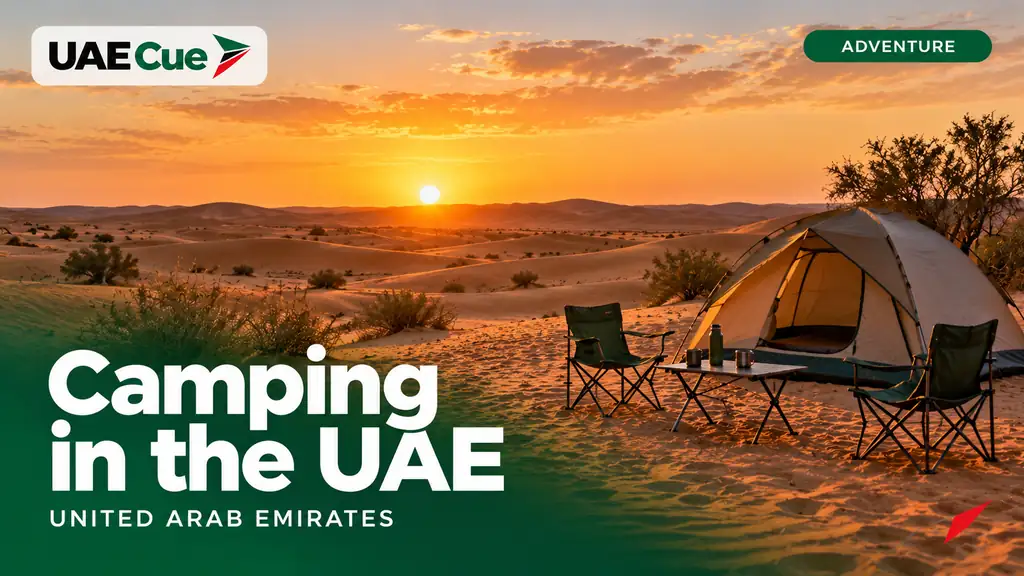
You can camp in the UAE, but the rules depend on the emirate and on how long you stay. For a night or a weekend, most families use official free sites such as Al Wathba Lake Camp in Abu Dhabi, open desert outside protected reserves, the mountain viewpoints of Jebel Jais, or paid campgrounds and glamping sites. Long-stay winter camps need a municipality permit (Dubai’s are in Al Aweer, from November to April), and camping in nature reserves, on restricted beaches or in wadis during rain can bring fines of AED 2,000 or more. The season runs from late October to April.
At a glance
- Season
- Late October to April; best November to March
- Free official site
- Al Wathba Lake Camp, Abu Dhabi: 13 tent and RV areas
- Long-stay permits
- Dubai (Al Aweer) and Umm Al Quwain, 3 to 6 months, mainly for Emirati families
- Caravans
- Free 30-day permit for Jebel Ali Public Beach, Dubai
- Never camp
- In nature reserves, in wadis during rain, or where signs forbid it
- Fines
- Typically from AED 2,000 for illegal camping or leaving rubbish in Sharjah and Fujairah
Last verified: 13 October 2026 against Dubai Municipality, Umm Al Quwain and Abu Dhabi announcements. Dubai’s 2026-27 winter camp applications usually open in the second half of October; we update this page when they do.
On this page
- Camping rules by emirate
- Dubai winter camps in Al Aweer
- Free and official campsites
- Glamping and paid campgrounds
- Beach camping
- Where you must not camp
- Leave no trace: fires and rubbish
- The federal laws behind the rules
- Camping season and weather
- What to pack
- Safety in the desert and mountains
- Change log
- Camping in the UAE FAQs
Camping rules by emirate
| Emirate | Short trips (a night or weekend) | Long-stay winter camps | Watch out for |
|---|---|---|---|
| Dubai | Overnight trips in open desert outside reserves are common; follow posted signs | Permit in Al Aweer, 1 November to 30 April, 3 to 6 months | No camping in the Dubai Desert Conservation Reserve or restricted parts of Al Marmoom |
| Abu Dhabi | Use official sites such as Al Wathba Lake Camp | Not a public permit scheme | Fines for unauthorised camping in protected areas, from about AED 5,000 in reserves |
| Sharjah | Designated desert areas, with a permit for stays | Municipality permits | Fines from AED 2,000 for unauthorised camping or littering |
| Ajman | Limited desert and beach areas | Municipality approval | Check local signs; beaches are patrolled |
| Umm Al Quwain | Desert and beach areas on the coast road | Winter permit, 3 to 6 months, AED 2,000 fee and AED 10,000 refundable deposit, for UAQ passport holders | No subletting or commercial use of permit sites |
| Ras Al Khaimah | Jebel Jais viewpoints and licensed campgrounds | Through the tourism authority’s licensed operators | Beach camping has been restricted in recent years; use licensed sites |
| Fujairah | Special permits needed for mountain and beach camping | Municipality permits | Fines up to AED 2,000; no open fires near dry vegetation, no non-biodegradable waste |
Rules are set by each municipality and change from season to season, so treat this table as the starting point and check the latest announcement for the place you plan to stay.
Dubai winter camps in Al Aweer
Dubai Municipality runs a long-stay winter camping season in Al Aweer, with serviced plots for families. The 2025-26 season opened for applications on 21 October 2025, with permits valid from 1 November to 30 April.
| Item | 2025-26 terms |
|---|---|
| Who can apply | Families, mainly UAE citizens with a Dubai-issued passport; check eligibility each season |
| How to apply | Dubai Now app or wintercamp.dm.gov.ae, with UAE PASS |
| Length | Minimum 3 months, maximum 6 months |
| Size | Up to 400 square metres per camp |
| Fee | 44 fils per square metre per week, about AED 176 a week for a full plot, plus small service fees |
| Deposit | AED 2,000, refunded after the camp is removed and the land restored |
| Processing | About two working days |
- Camps are for family use only and cannot be rented out or used commercially.
- Fires only in a raised fire pit (kewar); direct fires on the sand are banned.
- A fire extinguisher is compulsory, and floodlights, loudspeakers and fireworks are banned.
- Vehicles are limited to 20 km/h inside the camping area, and dune bikes are not allowed inside camps.
- The main entrance must face the street, and a sewage tank must be installed inside the plot.
- When the permit ends, the camp must be cleared and the land restored within a week.
Free and official campsites
| Site | Emirate | Cost | Good to know |
|---|---|---|---|
| Al Wathba Lake Camp | Abu Dhabi | Free | 13 camping areas for tents or RVs around a lake, with a 1.4 km walking path and a 1.2 km cycle track; about 45 minutes from the city |
| Al Qudra Lakes and Love Lake | Dubai | Free | Popular for overnight trips and stargazing; parts of the area sit inside the Al Marmoom reserve, so camp only where it is allowed |
| Jebel Ali Public Beach (caravans) | Dubai | Free permit | A Dubai Municipality no-objection certificate lets you park a caravan or trailer for up to 30 days, issued instantly online |
| Jebel Jais viewpoints | Ras Al Khaimah | Free | Public viewpoints along the mountain road; crowded at weekends, few facilities, cold at night in winter |
| Liwa and Tal Moreeb | Abu Dhabi | Free | Huge dunes at the edge of the Empty Quarter and dark skies, about 2.5 hours from Abu Dhabi; busiest during the Liwa Festival from 11 December |
Glamping and paid campgrounds
| Stay | Where | What it is | From, roughly |
|---|---|---|---|
| Hatta Dome Park | Hatta, Dubai | Glamping domes on the mountainside | About AED 1,000 to 1,150 a night |
| Hatta Caravan Park and Sedr Trailers | Hatta, Dubai | Serviced caravan pitches and vintage-style trailers | Varies by season |
| Longbeach Campground | Ras Al Khaimah | Beachfront domes and tents | Domes from about AED 469 a night |
| Bear Grylls Explorers Camp | Jebel Jais, Ras Al Khaimah | Cabins with survival courses | Courses from about AED 350 |
| Al Badayer Retreat | Sharjah desert | A Sharjah Collection desert lodge among red dunes | Varies by date |
| Hatta Wadi Hub campsites | Hatta, Dubai | Pitches near the trails and the dam | Budget |
Prices change with the season and the day of the week; weekends from November to March sell out first. For more on Hatta’s options, see our things to do in Hatta guide.
Beach camping
Beach camping is the most tightly controlled kind in the UAE. In Dubai, caravans can stay on Jebel Ali Public Beach with a free 30-day permit, but tents on city beaches are not allowed. In the northern emirates, rules vary by beach and change with the season, and some emirates have restricted beach camping in recent years. Use licensed beach campgrounds, or see our beach camping guide for the current list.
Where you must not camp
- Nature reserves: including the Dubai Desert Conservation Reserve, protected areas of Al Marmoom, Al Wathba Wetland Reserve and other wildlife reserves.
- Wadis during or after rain: flash floods arrive fast, and entering flooded wadis brings heavy fines and vehicle confiscation.
- Near construction sites, farms, military areas or private land.
- Border areas and military zones, including desert near the Oman and Saudi borders away from official roads.
- Anywhere with a no-camping sign, including many city beaches and parks.
Flood warning: if the National Centre of Meteorology issues a yellow, orange or red warning for rain, do not camp in or near wadis and valley floors, even if it is dry where you are. Water from rain in the mountains can reach dry wadis hours later.
Leave no trace: fires and rubbish
- Use a raised fire pit or a portable stove; never light fires directly on the sand or near dry plants.
- Bring your own firewood or charcoal; do not cut ghaf or other trees, which are protected.
- Take every scrap of rubbish home. Littering fines start at about AED 500 in Dubai and AED 2,000 in Sharjah.
- Keep music low, and no fireworks.
The federal laws behind the rules
Local permits sit on top of federal environmental law. Federal Law No. 24 of 1999 on protecting the environment bans damaging reserves, cutting plants and disturbing wildlife, and Federal Law No. 12 of 2018 on waste management covers dumping and burning rubbish. Fines under these laws can run into tens of thousands of dirhams, far more than a municipal camping fine, so cutting firewood from living trees, burning rubbish or leaving waste in the desert is never worth the risk. Police and municipal rangers patrol the popular camping areas most closely in the peak winter months.
Camping season and weather
| Month | Desert nights | Verdict |
|---|---|---|
| October | Warm, often above 25 degrees Celsius | Early season; hot by day |
| November and March | Mild, around 18 to 22 degrees | Excellent |
| December to February | Cool, 10 to 15 degrees in the desert; near freezing on Jebel Jais | Peak season; pack warm layers |
| April | Warm again | Last good weekends |
| May to September | Hot and humid | Not recommended |
What to pack
- A tent with sand pegs, sleeping bags rated for 10 degrees, and warm layers for winter nights.
- At least 4 litres of water per person per day, plus food that needs no fridge.
- A raised fire pit or gas stove, a fire extinguisher, a first aid kit and a torch.
- Rubbish bags, a shovel and a tarp.
- For the desert: a 4×4, a tyre deflator and pump, recovery boards, a tow rope, and ideally a second car.
- A power bank; phone signal is patchy in the dunes and mountains.
Safety in the desert and mountains
- Tell someone where you are going and when you will be back.
- Do not drive into the dunes without experience and recovery gear; go with another car.
- Check the weather and wind forecast; sandstorms and fog are common in winter.
- Shake out shoes and sleeping bags in the morning, and keep food sealed.
- In an emergency call 999 for police or 998 for an ambulance, and share your location.
- Camping in Dubai: the best spots near the city.
- Camping in Abu Dhabi: Al Wathba, Liwa and beyond.
- Stargazing in the UAE: the darkest skies to camp under.
- Adventure activities in the UAE: everything outdoors.
- Al Quaa: the UAE’s best-known stargazing camp spot.
Change log
- 13 October 2026: page created with 2025-26 permit terms; Dubai and Umm Al Quwain 2026-27 winter permit details to be added when announced.
Camping in the UAE FAQs
Is camping allowed in the UAE?
Yes, in permitted areas. Each emirate sets its own rules: use official sites such as Al Wathba Lake Camp, licensed campgrounds, or open desert outside protected reserves, and get a permit for long-stay winter camps.
Do you need a permit to camp in Dubai?
Long-stay winter camps need a Dubai Municipality permit in Al Aweer, valid from November to April. Caravans on Jebel Ali Public Beach need a free 30-day permit. Nature reserves are off limits.
Where can I camp for free in the UAE?
Al Wathba Lake Camp in Abu Dhabi is a free official site with 13 camping areas. Al Qudra Lakes in Dubai, Jebel Jais viewpoints in Ras Al Khaimah and the Liwa dunes are also popular free spots, where camping is allowed.
When is the camping season in the UAE?
From late October to April. November to March is best, with mild days and cool nights.
What is the fine for illegal camping in the UAE?
It depends on the emirate. Sharjah and Fujairah fine up to AED 2,000 for unauthorised camping or littering, and camping in protected reserves can cost AED 5,000 or more.
Can you camp on the beach in Dubai?
Not with tents on city beaches. Caravans and trailers can stay on Jebel Ali Public Beach with a free Dubai Municipality permit for up to 30 days.
Is glamping available in the UAE?
Yes. Popular options include Hatta Dome Park and the Hatta caravans in Dubai, Longbeach Campground and the Bear Grylls Explorers Camp in Ras Al Khaimah, and Al Badayer Retreat in Sharjah’s desert.