
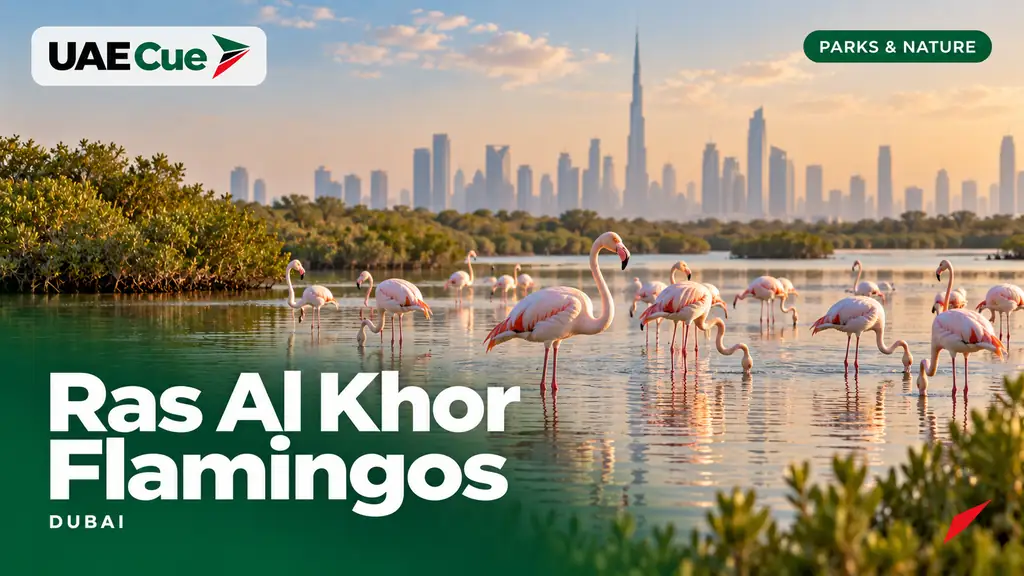
Ras Al Khor Wildlife Sanctuary is free to visit and open from 7:30am to 5:30pm from October to March, and from 6am to 6pm from April to September. The Flamingo Hide, open all year, is where you see the flock of greater flamingos, often just metres from the glass. Of the other two hides, the Lagoon Hide suits serious birdwatchers, and the Mangrove Hide was temporarily closed when we checked. Go between November and March for the most birds, in the early morning or late afternoon.
At a glance
- Entry
- Free; walk-in registration at the hide
- Winter hours
- October to March, 7:30am to 5:30pm
- Summer hours
- April to September, 6am to 6pm
- Best hide
- Flamingo Hide, open all year
- Best months
- November to March, peak migration
- Best time of day
- Early morning or the last two hours before closing
- Allow
- 30 to 60 minutes per hide
Last verified: 13 October 2026 against Dubai Municipality’s Ras Al Khor visitor pages, which listed the Mangrove Hide as temporarily closed.
On this page
The three bird hides
| Hide | Status | What you see | Best for |
|---|---|---|---|
| Flamingo Hide | Open all year | The resident flock of greater flamingos at close range, with herons and waders | Everyone, families and photographers |
| Lagoon Hide | Open | Open water towards the creek, waders and birds of prey such as ospreys and spotted eagles | Serious birdwatchers with binoculars or long lenses |
| Mangrove Hide | Temporarily closed when we checked | Mangroves and the birds and crabs that live among them, best at low tide | Return visits once it reopens |
Each hide has its own car park and entrance, and you cannot walk between them: drive from one to the next. The hides have glass viewing windows, benches, information boards about the birds and wetland, and binoculars or telescopes for visitors to use.
First visit? Go straight to the Flamingo Hide. Set your maps to “Ras Al Khor Wildlife Sanctuary Flamingo Hide”, which is signposted off Ras Al Khor Road on the way back towards the city. There is free parking next to the hide.
Flamingo feeding times
Rangers feed the flamingos near the Flamingo Hide during the day, which brings the flock closer to the windows. Visitors and guides usually report feeding around 10am and again in the mid to late afternoon, within a window of about 9am to 4pm. Times are not published officially and can change, so for the best chance of a close view, arrive mid-morning or from about 3:30pm.
Best months and best light
| Months | What to expect |
|---|---|
| October | Migration starts; numbers begin to build |
| November to February | Peak season: thousands of migratory birds join the flamingos |
| March to May | Spring passage; quieter, with some migrants moving through |
| June to September | Fewer species, but flamingos are present and fed year-round; go at 6am in the heat |
For photos, the soft light just after opening and in the last hour before closing is best, and the Dubai skyline, with the Burj Khalifa on the horizon, often reflects in the still lagoon. Bring a zoom lens of 200 mm or more for portraits; at the Flamingo Hide a phone works too when the birds are close.
Birds to look for
The sanctuary records around 450 species of animals and dozens of plant species. Besides the greater flamingos, regular sightings include:
- Waders: black-winged stilts, pied avocets, greenshanks, sandpipers, plovers, dunlins and curlews.
- Herons and egrets: grey herons, great egrets, western reef herons and little bitterns.
- Birds of prey: ospreys, greater spotted eagles and marsh harriers, especially in winter.
- Others: spoonbills, cormorants, Caspian terns, kingfishers, bee-eaters and Indian rollers.
Rules inside the hides
- Register at the hide on arrival; staff may ask to see ID.
- The hides are quiet zones: no phone calls, loud talking or music.
- No pets, food, drinks or smoking inside the hides.
- Stay behind the fences and the “No Entry” signs; the wetland itself is closed to the public.
- No drones, and do not throw food or anything else to the birds. Breaking the rules in a protected area can bring heavy fines.
- Groups and schools book ahead through Dubai Municipality’s Ras Al Khor pages; individuals and families can walk in.
About the sanctuary
Ras Al Khor, Arabic for “head of the creek” and sometimes translated as “Cape of the Creek”, sits where Dubai Creek once ended before the Dubai Water Canal extended it, between the Ras Al Khor industrial area, Al Jaddaf and Nad Al Hamar, a few minutes from Downtown Dubai. Its salt flats, mudflats, mangroves and lagoons were declared a protected area on 1 March 1998, and in 2007 it became a Ramsar Wetland of International Importance, one of the few protected wetlands inside a major city anywhere. Dubai Municipality manages it, and the hides were set up with WWF’s UAE office. It is also a nursery for fish and crabs, and its mangroves help protect the creek’s water quality.
Getting there
The sanctuary is beside Ras Al Khor Road (E44), the stretch between Al Khail Road and Sheikh Mohammed Bin Zayed Road, about 15 minutes by car from Downtown Dubai and Business Bay and 10 minutes from Deira, Bur Dubai and Dubai Festival City. Drive to each hide separately: the Flamingo Hide has its own signposted turn-off and free car park. Taxis can drop you at the Flamingo Hide, but ask the driver to wait or book a return, as there is nowhere to pick up a cab nearby. Bring water and a hat; the walk from the car to the hide is short but there is little shade outside.
Other places to see flamingos in the UAE
| Place | Emirate | Why go |
|---|---|---|
| Al Wathba Wetland Reserve | Abu Dhabi | One of the UAE’s largest flamingo populations, up to around 4,000 birds in spring and autumn, with 1.5 km and 3 km walking trails and a hide |
| Al Zorah Nature Reserve | Ajman | Mangroves where flamingos are often seen, best by kayak |
| Al Qudra Lakes | Dubai | Desert lakes where flamingos sometimes visit, alongside swans and ducks |
Flamingos move between wetlands across the year, so numbers at any one site vary from week to week.
- Best parks in Dubai: every major park compared.
- Mushrif Park: ghaf forest trails and birdwatching.
- Mangrove kayaking: paddle among the mangroves.
- Free things to do in Dubai: more days out for nothing.
- Marsa Boulevard: cafes and markets at Dubai Creek Harbour, next to the sanctuary.
Ras Al Khor FAQs
Is Ras Al Khor Wildlife Sanctuary free?
Yes. Entry is free. Individuals and families walk in and register at the hide; groups book ahead through Dubai Municipality.
What are Ras Al Khor Wildlife Sanctuary timings?
From October to March it opens 7:30am to 5:30pm, and from April to September 6am to 6pm.
When is the best time to see flamingos in Dubai?
November to March, when migration brings the most birds, early in the morning or in the late afternoon. Flamingos are present and fed all year.
Which hide is best at Ras Al Khor?
The Flamingo Hide, open all year, where the flamingo flock feeds close to the windows. The Lagoon Hide suits serious birdwatchers, and the Mangrove Hide was temporarily closed when we checked.
Can you walk between the hides at Ras Al Khor?
No. Each hide has its own entrance and car park, so you drive from one to the next.
Are there other places to see flamingos in the UAE?
Yes. Al Wathba Wetland Reserve in Abu Dhabi has one of the largest flamingo flocks in the country, and flamingos are also seen at Al Zorah in Ajman and sometimes at Al Qudra Lakes.